
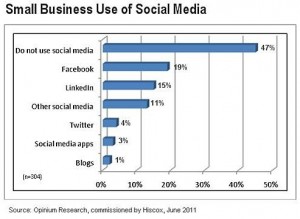
- Source: Opinium Research, commissioned by Hisox, June 2011
As a small business owner, I know firsthand that social media is not only an economical way to advertise to my target market, but is also a superior marketing mechanism for many reasons. I am able to track- in real-time, many nuggets of important information like referring URL’s; click-through rates on display advertising; stats for SEO purposes; time spent per page of my website and how individual promotions are performing.
I was therefore shocked upon reading a recent poll conducted by Hiscox, a small business insurance provider, which found that only 12% of small business owners who were polled considered using social media a “must” for their business.
Social media adoption varies greatly by company size according to the study in that 62% of businesses with 50-249 employees use social media for business, compared with 46% of those with 1-9 employees. 50% of respondents said they couldn’t do without word-of-mouth marketing while just 4% said the same about social media marketing.
The irony is that social media encompasses many forms of word-of-mouth marketing indicated by the ‘Likes’ you see on your friends’, colleagues’ and family members’ Facebook pages. In addition, Facebook is now a strong referral source as it is becoming increasingly common for people to post questions such as one I posted last month, “Anyone have any recommendations for a daycare center that offers a foreign language program?”
Of all social media channels, Facebook was deemed the most important for growth followed by LinkedIn at 18%, a company blog at 8% and YouTube at 6%. LinkedIn is often referred to as a professional Facebook because the profiles include education and career information primarily vs. a person’s entertainment, sports and music preferences. Many people use it to network within key industries, search employment and build a repertoire of referrals from former colleagues, managers, mentors and instructors.
Twitter is ideal for establishing credibility as an expert in a subject or field, and gaining ‘followers.’ Whether one owns a Yoga studio or a tutoring facility for adolescent children, tweeting information such as new studies, trends or an article in which the small business owner is showcased asserts his/her credibility and attracts new followers of that information…and future customers.
Like anything else in life, be sure to define your goals before embarking on a social media campaign strategy. 27% of survey respondents use social media to generate brand awareness and 22% to generate sales. A quarter of respondents cited customer service and research individually at 10%, and improve SEO at 5%, as top goals.
Surprisingly, only 11% use social media to promote new offers and promotions which is actually a good thing. The more offers available, the more challenging it becomes for the marketer to cut through the ‘noise’ to gain a prospect’s attention. More importantly, social media is poised for organic marketing meaning that people prefer to seek out and receive information, referrals, etc. from their ‘friends’ or colleagues vs. a hard-core sales pitch.
Traditional marketing will always remain somewhat valuable however social media should be at the top of small business owners’ marketing strategy plans.